.svg)


What Happens During a Professional Pool Leak Detection Visit in Columbia, MS
September 10, 2026
Read more
Not sure what to call a pool leak until it's too late? Here are the signs Laurel homeowners miss, why they happen, and how A & H finds and fixes them fast.
Laurel pool owners deal with one of the more confusing aspects of pool ownership: figuring out whether the water your pool is losing is a problem or just the Mississippi summer doing what it does. Evaporation in South Mississippi is real and measurable, especially during July and August when temperatures sit in the 90s and humidity keeps the air heavy. But evaporation has a ceiling, and when your pool is losing water faster than that ceiling allows, something else is going on. A & H Leak Detection and Repair serves Laurel and surrounding Jones County with veteran-owned pool leak detection, inspections, and repairs, and this guide covers exactly what to watch for and what to do when you suspect your pool has a leak.
Mississippi's climate and soil conditions create specific challenges for pool longevity that homeowners in drier parts of the country do not deal with at the same level.
Heavy rainfall and soil saturation. South Mississippi receives more than 55 inches of rain per year on average, and the Jones County area sees periods of prolonged saturation that affect the soil around pool structures. When soil becomes heavily saturated and then dries out, it shifts. That movement puts stress on pool shells, underground plumbing connections, and the fittings where plumbing lines meet the pool structure. Over time, repeated wet-dry cycles can open up small gaps at these connection points that gradually become leak sources.
Clay-heavy soils. Much of the Laurel area sits on clay-heavy soil that expands significantly when wet and contracts when dry. The same expansion and contraction cycle that causes foundation issues in older homes creates stress on pool plumbing and shells in the same way. A fitting that holds up fine in stable soil conditions can develop a gap as the surrounding soil moves around it through the seasons.
Heat and UV exposure. Laurel's long, hot summers accelerate wear on plastic components including skimmer bodies, weir doors, and gaskets. UV exposure hardens and cracks plastic over time, and the heat accelerates the aging of the rubber gaskets that create watertight seals at the skimmer faceplate and around light fixtures. Once a gasket hardens and cracks, the seal fails and water escapes.
Pool age. Laurel has a mix of newer residential construction and established neighborhoods with pools that were built 15 to 25 years ago. Pools in that older range are approaching or past the service life of their original plumbing fittings, skimmer hardware, and light niche seals. If a pool has never had these components inspected or replaced, the likelihood of a slow leak somewhere in the system is high.
A pool should not need water added more than once a week under normal conditions. If you are topping off the pool more frequently, and particularly if you are doing it every few days, something beyond normal evaporation is at work.
Mississippi summer evaporation runs high, but even in peak heat a pool typically loses no more than a quarter inch of water per day to evaporation alone. If your pool is dropping a half inch or more per day consistently, that rate is not explained by evaporation.
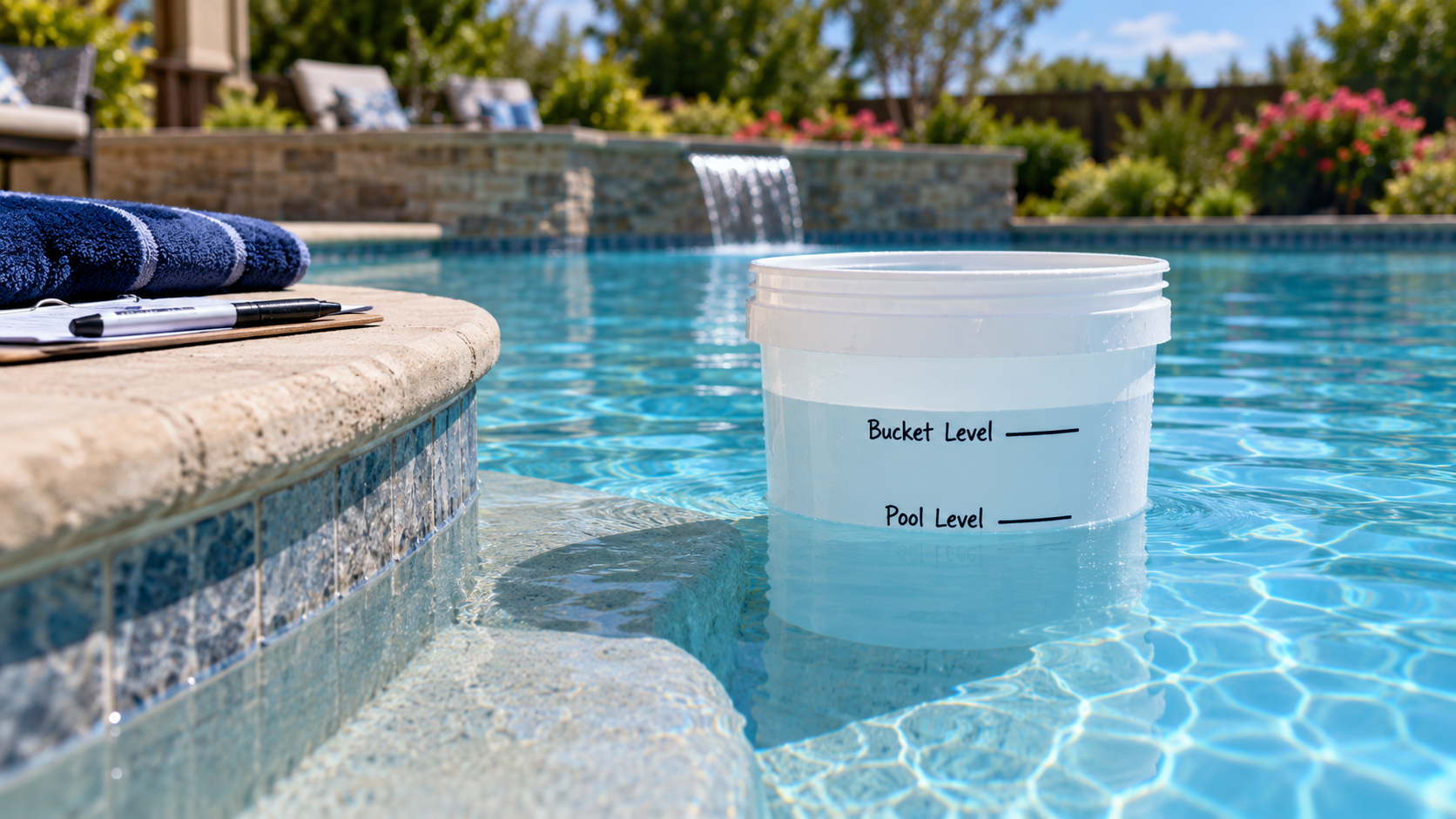
The bucket test is the most reliable DIY method for separating evaporation from a real leak. Fill a five-gallon bucket with pool water, place it on a step so it sits in the pool, and mark both the pool water level and the bucket water level with tape or a marker. Turn off the auto fill if your pool has one. Check both levels after 24 hours.
Both the pool and the bucket will drop due to evaporation, because both are exposed to the same conditions. If the pool dropped more than the bucket, the difference represents water loss beyond evaporation, which means you have a leak worth investigating.
If your pool's water level drops and then stops falling right at the bottom of the skimmer opening, the skimmer is almost certainly involved. Water is escaping through the skimmer body, the faceplate gasket, or the throat connection to the pool wall, and it stops once the water level falls below the leak point. This is one of the most consistent and telling signs of a skimmer leak.
If your pool has an automatic fill valve and you notice it running more frequently than usual, or running for extended periods, the auto fill is compensating for water loss. The system cannot distinguish between evaporation and a leak. It simply adds water when the level drops. A constantly running auto fill is an early warning worth paying attention to.
Persistently damp soil near the pump, filter, or equipment connections without a clear source like recent rain points to an underground plumbing leak near the equipment pad. These leaks are not always visible because the water drains into the surrounding soil before it surfaces. If you notice the ground stays soft or wet in an area near your pool equipment, it warrants a professional assessment.
When a suction-side plumbing line develops a crack or a loose fitting, it draws air into the system along with water. That air travels through the pump and returns to the pool through the jets as bubbles. Consistent air in the return jets, particularly when the pump is running normally, often indicates a suction-side plumbing leak.
Cracks in the pool plaster, gunite, or the surrounding deck are not always leak sources immediately, but they are worth monitoring. A structural crack in the pool shell that reaches through the surface allows water to escape into the surrounding soil. Cracks in the deck near the pool edge can indicate soil movement that may also be stressing underground plumbing.
A pool that is losing water is constantly being refilled, either manually or through the auto fill. Fresh water dilutes the pool's chemical balance, which can make it harder to maintain proper sanitizer levels. If you find yourself dealing with recurring algae problems despite proper treatment, a slow leak that is constantly diluting the chemistry may be a contributing factor.
Run the bucket test if you have not already. Mark the water level at the skimmer throat and note whether the water stabilizes there. These two simple checks narrow down the likely source before you call for professional help and give the technician useful information to start from.
Turn off the auto fill before running the bucket test so the system is not masking the actual rate of water loss.
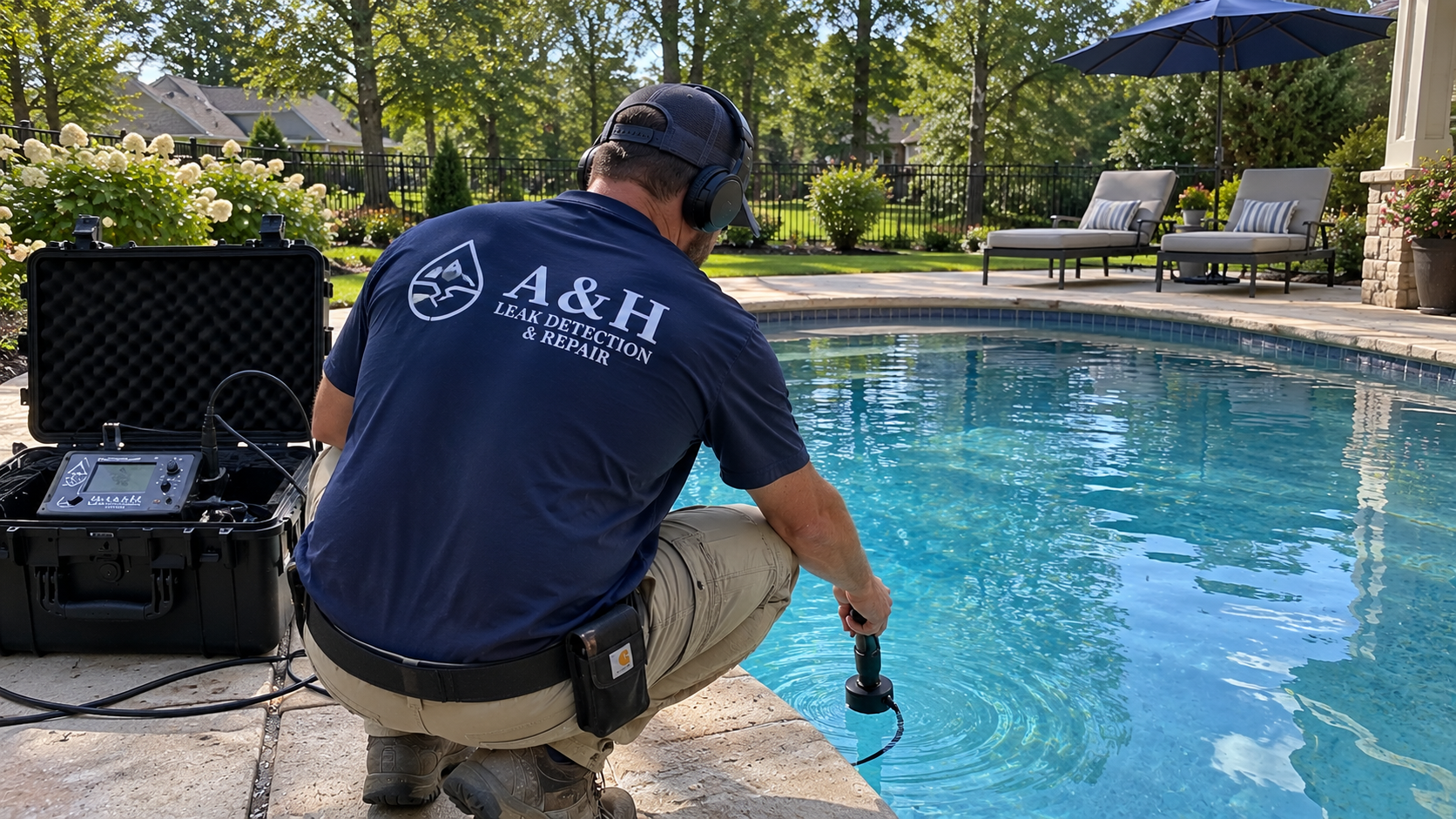
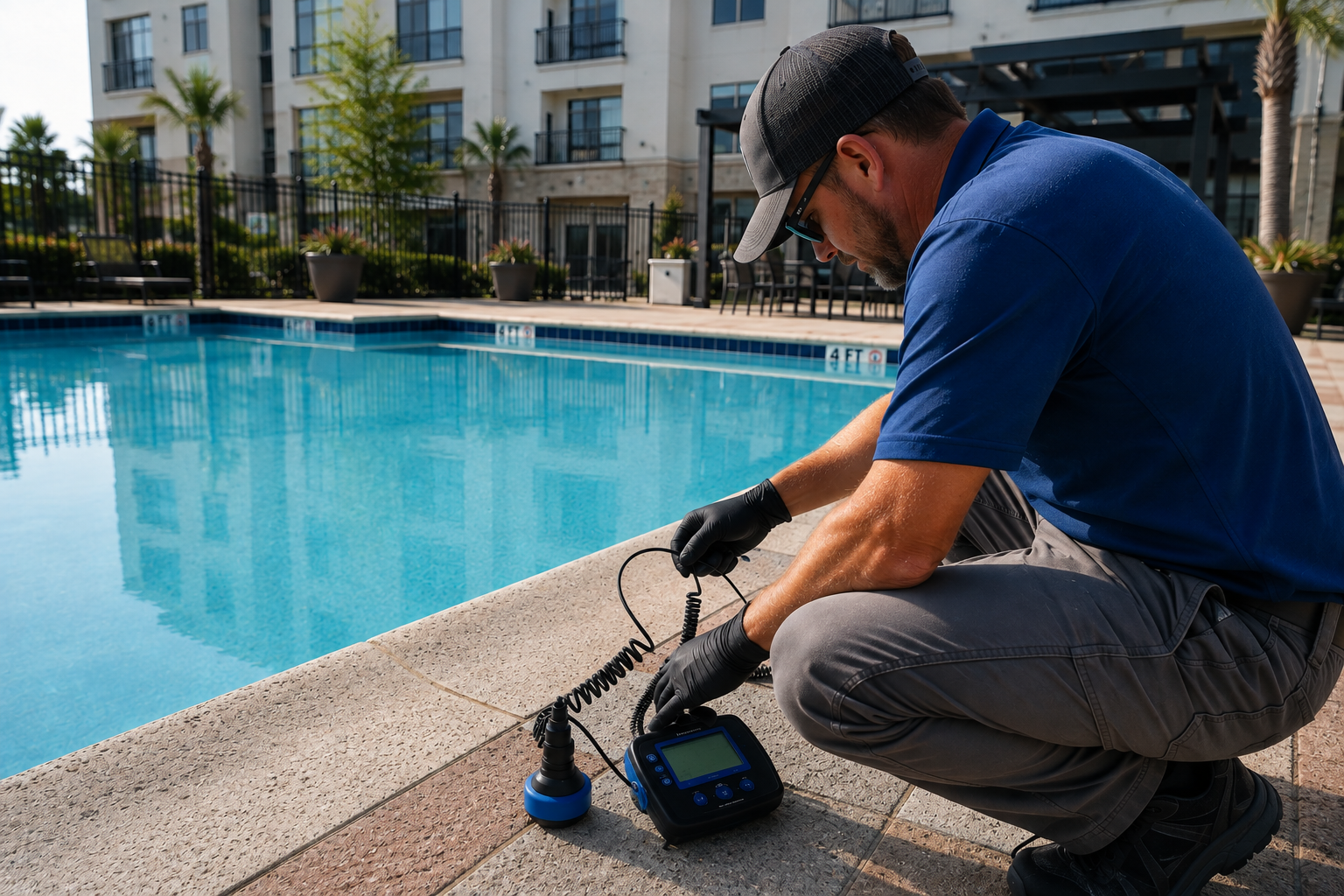
DIY methods can confirm that a leak exists and sometimes point toward a general area, but locating the specific source accurately requires professional equipment. A & H Leak Detection and Repair uses LeakTronics electronic detection equipment, pressure testing, and dye testing to pinpoint the source precisely before any repair work begins.
The detection process covers each component of the pool system individually. Pressure testing isolates each plumbing line to confirm whether it holds pressure. Dye testing confirms active leak points at fittings, the skimmer faceplate, return eyeballs, and light niches. Electronic acoustic detection listens for the sound signature of water escaping under pressure in underground lines.
At the end of the detection visit, you know exactly where the leak is and what the repair involves. There is no guessing and no unnecessary excavation.
Repair approach depends entirely on what the detection reveals. A failed skimmer gasket is a straightforward same-visit repair. A cracked skimmer body may require replacement. A leaking underground plumbing line is repaired using non-invasive trenchless methods wherever possible, which means no tearing up your deck or yard. A structural crack in the pool shell is patched and reinforced.
A & H Leak Detection and Repair handles detection and repair as a complete service. You are not managing two separate contractors or waiting for a second appointment to get the work done.
In South Mississippi's climate, a pool typically loses between one eighth and one quarter inch of water per day to evaporation during hot weather. Anything consistently above that range, especially during periods without significant splash-out, warrants a leak investigation.
The bucket test and the water-level-at-the-skimmer observation can tell you that a leak exists and sometimes suggest a general area. However, accurately locating the specific source requires pressure testing and electronic detection equipment. Attempting repairs based on a guess at the source often misses the actual leak and can create additional problems.
Yes. Laurel and Jones County are within our service area. A & H Leak Detection and Repair serves communities within 50 miles of Hattiesburg, which includes Laurel, Petal, Purvis, Columbia, Collins, and surrounding South Mississippi communities.
Most pool leak detection visits take two to four hours depending on the size of the pool and the complexity of the plumbing system. When the leak source is straightforward, repairs can often be completed in the same visit. We provide a clear timeline and upfront pricing before any work begins.
Coverage varies significantly by policy. Some policies cover sudden and accidental water damage but exclude gradual leaks. Others cover the detection cost but not the repair. We recommend contacting your insurance provider directly to understand your specific coverage before assuming the repair will or will not be covered.
A & H Leak Detection and Repair is a veteran-owned pool leak detection and repair specialist serving Laurel, Jones County, and communities throughout South Mississippi within 50 miles of Hattiesburg. Our LeakTronics-certified technicians use advanced electronic detection and non-invasive repair methods to find and fix pool leaks accurately and efficiently. Call (601) 466-8082 or contact us online for a free estimate.